
Jun 26, 2026
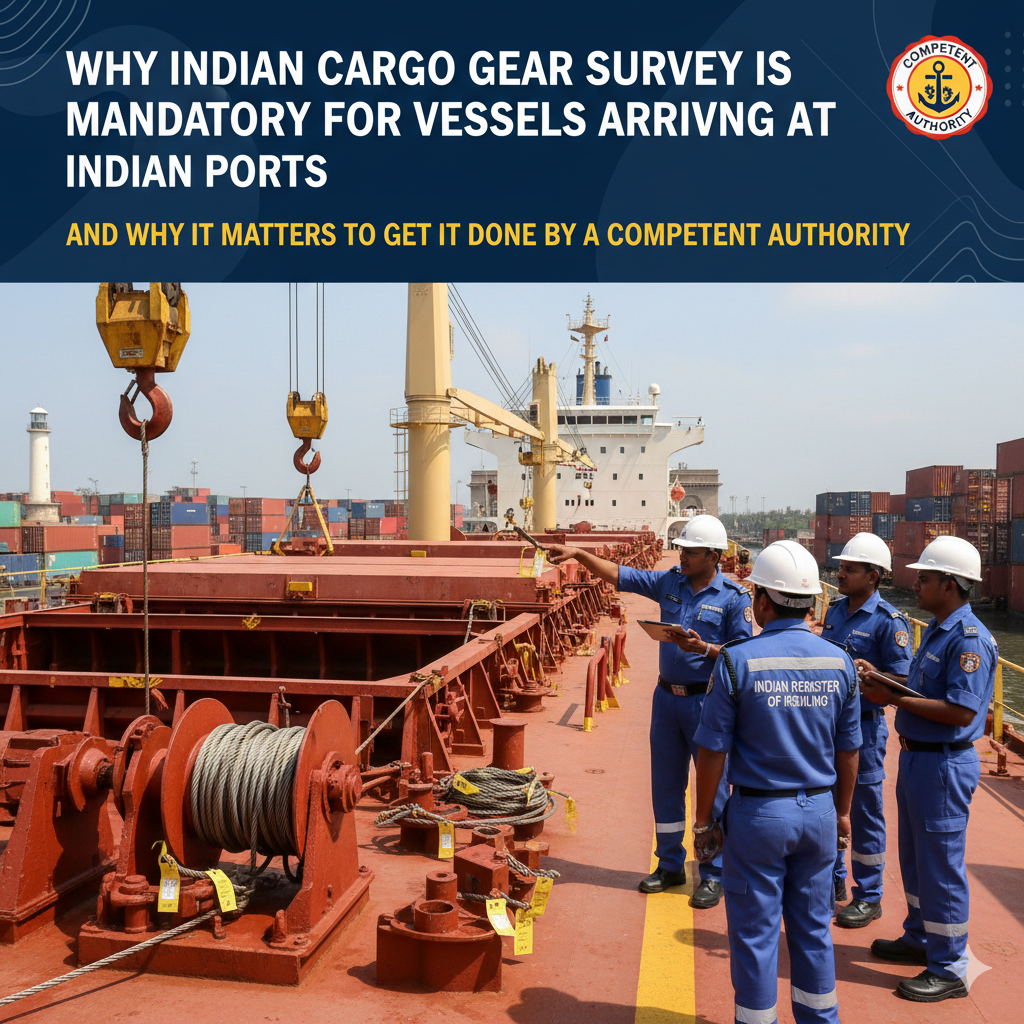
Why Indian Cargo Gear Survey Is Mandatory for Vessels Arriving at Indian Ports And Why It Matters to Get It Done by a Competent Authority
Introduction
Every vessel entering Indian ports must undergo a Cargo Gear Survey as per the
Directorate General of Shipping (DGS) and Indian Port regulations. This survey
is not just a procedural formality it is a critical inspection process that
ensures the vessel’s lifting appliances, derricks, cranes, and associated gear
are in safe and operational condition. Without a valid cargo gear certificate
from a competent authority, vessel operations can be delayed or even halted,
leading to financial and operational losses for ship owners and charterers.
Why the Cargo Gear Survey Is Done
The Indian Cargo Gear Survey is conducted to verify that all lifting equipment
and accessories on board are maintained, tested, and certified as per statutory
requirements under the Indian Dock Workers (Safety, Health and Welfare)
Regulations, 1990 and DGS guidelines.
Its primary purpose is to:
- Ensure the safety of dock workers and vessel crew
during cargo handling operations.
- Prevent accidents and mechanical failures during
loading or discharging.
- Maintain compliance with Indian Port and Marine safety
regulations.
- Ensure smooth clearance and minimize detention at port.
How the Survey Is Conducted
The Cargo Gear Survey involves a detailed inspection carried out by an
authorized and experienced competent person or organization recognized by the
Directorate General of Shipping.
The process includes:
- Visual Inspection
– Checking the physical condition of cranes, derricks, wire ropes, hooks,
shackles, and spreader beams.
- Load Testing
– Verifying the safe working load (SWL) through test loads and ensuring
the equipment can handle specified capacity without deformation or
failure.
- Certification Verification – Ensuring all gear and lifting appliances have valid
test certificates and are documented properly.
- Issuance of Cargo Gear Certificate (Form 1 & 2) – Upon successful completion, the surveyor issues the
necessary statutory certificates, which are mandatory for cargo operations
at Indian ports.
Importance of Having a Competent
Authority
Only an authorized and experienced surveyor who understands the DGS
regulations, Indian Port procedures, and international safety standards can
conduct a valid Cargo Gear Survey. Engaging unqualified or unauthorized
agencies may result in:
- Rejection of certificates by port authorities.
- Delays in cargo operations.
- Penalties or detentions imposed by inspectors.
- Risk of safety incidents due to improper inspection.
At Solanki Ship Care, our
certified professionals are well-versed with the Indian maritime regulations
and port-specific requirements. We ensure every survey is carried out
precisely, maintaining full compliance and ensuring the safety and operational
readiness of your vessel.
Awareness for Ship Owners
Many ship owners or operators underestimate the importance of conducting the
Cargo Gear Survey through a recognized competent authority. Lack of awareness
can lead to operational disruptions, financial losses, and reputational risks.
Ship owners should always verify that:
- The surveyor or company is approved by the Directorate
General of Shipping (India).
- All lifting gear certificates are valid and up to date.
- The survey is scheduled before vessel arrival to avoid
port delays.
Conclusion
The Indian Cargo Gear Survey is a mandatory and safety-critical requirement for
all vessels operating in Indian waters. Conducting it through a competent,
experienced, and authorized authority like Solanki Ship Care not only
ensures compliance but also safeguards operational efficiency and safety at
port.
Solanki Ship Care – Ensuring Safety,
Compliance, and Seamless Vessel Operations at Indian Ports.