
Jun 26, 2026
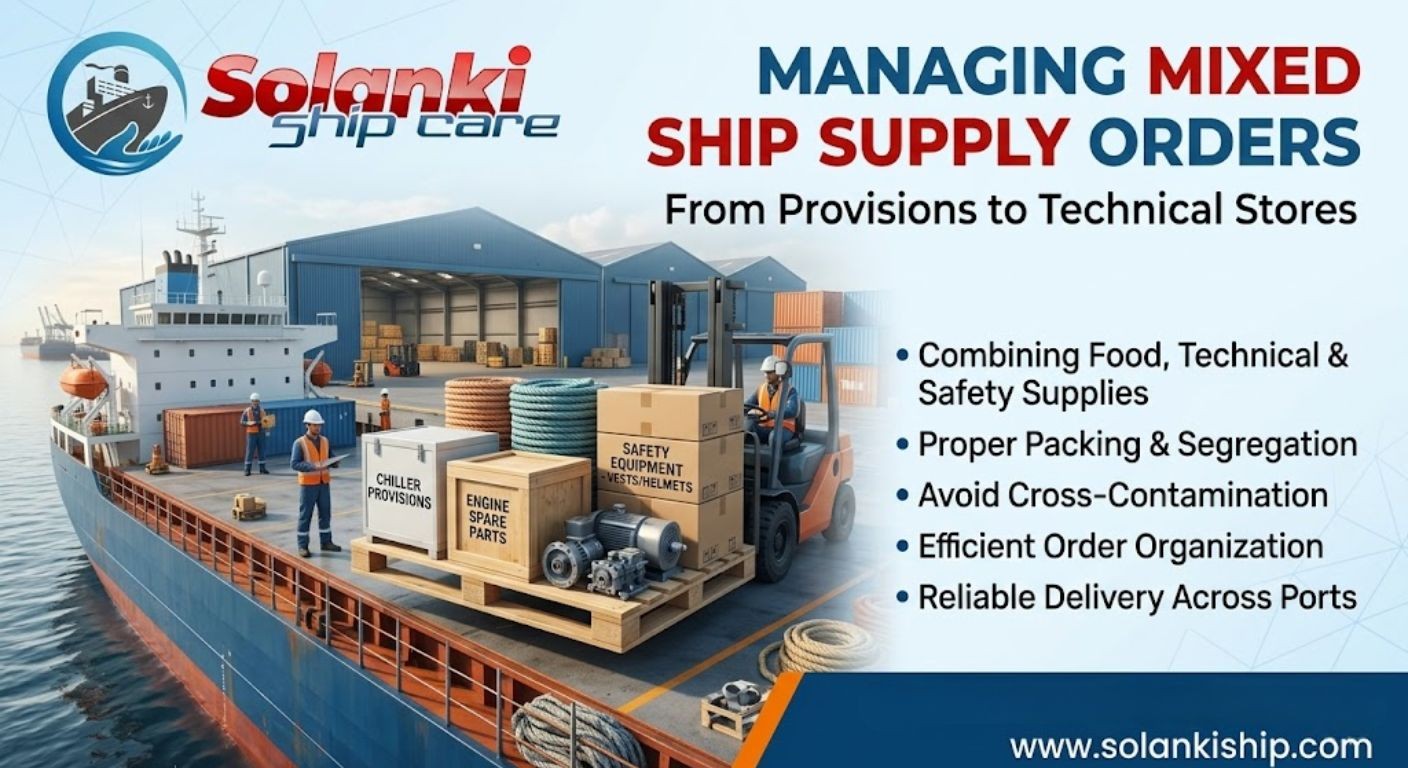
MANAGING MIXED SHIP SUPPLY ORDERS: FROM PROVISIONS TO TECHNICAL STORES
Solanki Ship Care expertly handles mixed ship
supply orders by combining provisions, technical stores, and safety equipment
in a structured and organized manner. Their systematic packing, segregation,
and quality control procedures ensure safe delivery while preventing
cross-contamination, product damage, and operational delays across all major
Indian ports.
ENSURING
SMOOTH HANDLING OF MIXED SHIP SUPPLY ORDERS
Managing mixed ship supply orders requires precision, planning, and
professional coordination. Vessels often request a combination of food
provisions, bonded stores, technical equipment, and safety supplies in a single
delivery. Without proper organization, such mixed orders can lead to
contamination, misplaced items, or damaged goods.
Solanki
Ship Care (www.solankiship.com) uses structured supply
management practices to ensure mixed orders are organized, packed, and delivered
efficiently without compromising quality or safety.
1.
COMBINING FOOD, TECHNICAL, AND SAFETY SUPPLIES
Handling Diverse Supply Requirements in One Delivery
Mixed ship supply orders typically include fresh provisions, dry stores, engine
spares, cabin items, chemicals, and safety equipment. Each category has
different storage and handling requirements, making proper coordination
essential.
Food
supplies must be handled hygienically, technical stores require protective
packing, and safety items must remain easily identifiable for quick access.
Combining all these items without confusion requires systematic planning.
Solanki
Ship Care categorizes each order into supply groups, ensuring food items,
technical stores, and safety equipment are handled according to their specific
requirements.
2.
CHALLENGES IN PACKING AND SEGREGATION
Avoiding Confusion During Delivery Operations
Packing mixed orders presents several challenges, including limited space,
multiple packaging standards, and varying handling conditions. Incorrect
segregation may result in food items being placed alongside chemicals or heavy
equipment damaging fragile supplies.
Proper
labeling, category-wise packing, and item separation are essential to maintain
supply integrity. Organized packing also helps vessel crews quickly identify
and store supplies onboard.
Solanki
Ship Care follows strict packing protocols, using color-coded labels, separated
containers, and category-based packaging to ensure smooth handling during
delivery.
3.
AVOIDING CROSS-CONTAMINATION AND DAMAGE
Protecting Quality and Safety of Ship Supplies
Cross-contamination is a major risk when food provisions are transported with
technical or chemical supplies. Strong odors, leaks, or improper packaging can
compromise food safety and damage sensitive equipment.
Heavy
items such as spare parts can also crush delicate supplies if not packed
properly. Proper segregation and protective packaging prevent such issues.
Solanki
Ship Care uses sealed containers for food provisions, protective cushioning for
technical items, and dedicated packaging zones to avoid contamination and
damage.
4.
EFFICIENT ORDER ORGANIZATION
Improving Delivery Speed and Accuracy
Efficient organization of mixed orders ensures faster loading, accurate
delivery, and minimal confusion onboard. Clearly labeled packages allow crew
members to identify supplies quickly and store them in the correct locations.
Order
organization also helps reduce delays during port operations, especially when
delivery windows are limited. Structured packing lists and grouped supplies
improve operational efficiency.
Solanki
Ship Care prepares detailed packing lists and organizes supplies by department,
ensuring smooth delivery and quick onboard distribution.
5.
HOW SOLANKI SHIP CARE MANAGES MIXED SUPPLY DELIVERIES
Professional Coordination and Structured Supply Management
Solanki Ship Care follows a systematic approach to managing mixed ship supply
orders. Their process focuses on proper segregation, protective packaging,
accurate labeling, and efficient delivery coordination.
Their
mixed supply management includes categorized packing, hygienic food handling,
technical item protection, safety equipment identification, and organized
delivery documentation.
With
operations across Mumbai, Chennai, Kandla, Visakhapatnam, Kolkata, Mundra,
Haldia, Cochin, Paradip, Dahej, and all major Indian ports, Solanki Ship Care
ensures reliable mixed ship supply deliveries without confusion or delays.
CONCLUSION
Managing mixed ship supply orders requires careful planning, segregation, and
professional handling. Combining provisions, technical stores, and safety
supplies in one delivery can be challenging without proper organization.
Solanki
Ship Care ensures efficient mixed supply management through structured packing,
contamination prevention, and clear labeling. Their professional approach
guarantees safe, organized, and timely deliveries for vessels across all major
Indian ports.
For
reliable and well-organized mixed ship supply services, contact Solanki Ship
Care at www.solankiship.com.
FREQUENTLY
ASKED QUESTIONS (FAQ)
Q1.
What are mixed ship supply orders?
Mixed orders include provisions, technical stores, safety equipment, and other
ship supplies delivered together.
Q2.
Why is segregation important in mixed deliveries?
Segregation prevents contamination, avoids damage, and ensures proper handling
of different supply types.
Q3.
How can cross-contamination be avoided in ship supplies?
By separating food items, using sealed packaging, and maintaining dedicated
packing zones.
Q4.
What challenges arise in mixed ship supply deliveries?
Packing complexity, risk of damage, labeling confusion, and handling different
storage requirements.
Q5.
How does Solanki Ship Care manage mixed supply orders?
Through categorized packing, proper labeling, contamination prevention, and
efficient delivery coordination.