
Jun 26, 2026
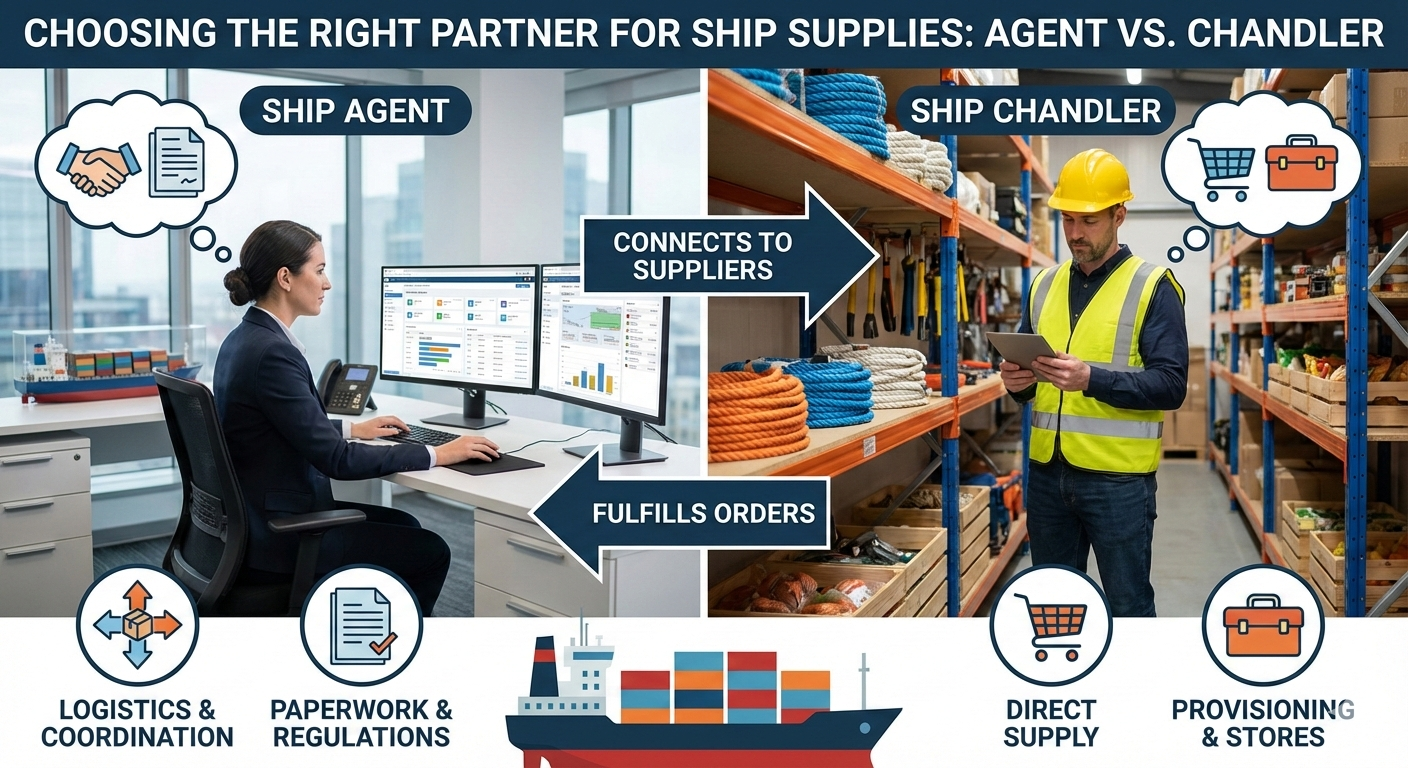
CHOOSING THE RIGHT PARTNER FOR SHIP SUPPLIES: AGENT VS. CHANDLER
Introduction
Efficient ship supply management plays a critical role in maintaining vessel
performance, crew welfare, and operational continuity. One of the most common
questions faced by shipowners, operators, and masters is whether to rely on a
ship agent or work directly with a ship chandler for vessel supplies. While
both play important roles in port operations, their responsibilities,
limitations, and value propositions differ significantly. Understanding these
differences helps stakeholders make informed decisions that improve cost
efficiency, accountability, and service reliability. Solanki Ship Care stands
out as a trusted ship supply partner by offering direct, transparent, and
dependable chandling solutions tailored to vessel needs.
1.
Understanding the Difference Between Ship Agents and Ship Chandlers
Distinct Roles in Port Operations
Ship agents and ship chandlers support vessels in different but complementary
ways during port calls.
Ship Agent Role:
• Acts as the vessel’s local representative at the port
• Coordinates port formalities, documentation, and clearances
• Liaises with port authorities, terminals, and service providers
• Arranges services but usually does not supply goods directly
Ship Chandler Role:
• Direct supplier of ship provisions, stores, and consumables
• Handles sourcing, packing, and delivery of supplies
• Focuses on quality, timeliness, and compliance of supplied items
• Works closely with vessels to meet operational requirements
Why It Matters
Understanding these distinct roles helps vessel operators choose the right
partner based on whether they need coordination services or actual supply
execution.
2.
Responsibilities and Limitations of Each
What Each Partner Can and Cannot Do
Both ship agents and ship chandlers have defined responsibilities, along with
limitations that affect service outcomes.
Ship Agent Responsibilities & Limitations:
• Manages port logistics and regulatory processes
• Coordinates third-party suppliers on behalf of the vessel
• Limited control over pricing, quality, and delivery timelines of supplies
• Accountability may be indirect when supplies are outsourced
Ship Chandler Responsibilities &
Limitations:
• Supplies provisions, bonded stores, technical and cabin items
• Ensures quality control and timely delivery
• Directly accountable for supplied goods
• Does not handle overall port documentation unless coordinated
Why It Matters
Clear accountability and role clarity reduce misunderstandings, delays, and
operational risks during port stays.
3.
When to Work with a Ship Chandler Directly
Direct Supply for Better Control
In many operational scenarios, working directly with a ship chandler provides
significant advantages.
Ideal Situations to Engage a Ship Chandler Directly:
• Urgent or short-notice supply requirements
• Need for cost transparency and competitive pricing
• High-volume or specialized supply demands
• Ports where local chandlers have strong logistical networks
• When quality assurance and delivery timelines are critical
Why It Matters
Direct coordination with a ship chandler reduces intermediaries, speeds up
communication, and ensures supplies meet vessel-specific standards.
4.
Cost, Efficiency, and Accountability Comparison
Evaluating the Practical Impact
Choosing between an agent-mediated supply and direct chandling affects
operational efficiency and costs.
Cost Comparison:
• Agents may add coordination margins to supplier costs
• Direct chandlers offer clearer pricing and better cost control
Efficiency Comparison:
• Direct communication with chandlers enables faster decision-making
• Reduced delays caused by multiple coordination layers
Accountability Comparison:
• Ship chandlers take full responsibility for supplied goods
• Clear accountability simplifies issue resolution and claims handling
Why It Matters
Transparent pricing, faster response times, and single-point accountability
improve operational reliability and budget management.
5.
Why Solanki Ship Care Is a Trusted Ship Supply Partner
Reliable, Direct, and Vessel-Focused
Support
Solanki Ship Care combines industry expertise with a customer-centric approach
to deliver dependable ship supply solutions.
Our Strengths Include:
• Comprehensive range of provisions, bonded stores, and ship supplies
• Strong local sourcing network ensuring quality and availability
• Transparent pricing with no hidden costs
• Timely delivery aligned with vessel schedules
• Direct accountability and responsive communication
Why Choose Solanki Ship Care
With a proven track record, operational reliability, and commitment to service
excellence, Solanki Ship Care ensures vessels receive the right supplies at the
right time, without complications.
Conclusion
Making the Right Choice for Ship Supplies
Both ship agents and ship chandlers play vital roles in maritime operations,
but their functions serve different purposes. While agents excel in
coordination and port formalities, ship chandlers deliver direct value through
supply execution, cost efficiency, and accountability. Knowing when to engage
each partner helps shipowners and operators optimize operations and reduce
risks. By offering direct, transparent, and reliable supply services, Solanki
Ship Care emerges as a trusted ship supply partner, supporting vessels with
efficiency, confidence, and consistency across every port call.