
Jul 04, 2026
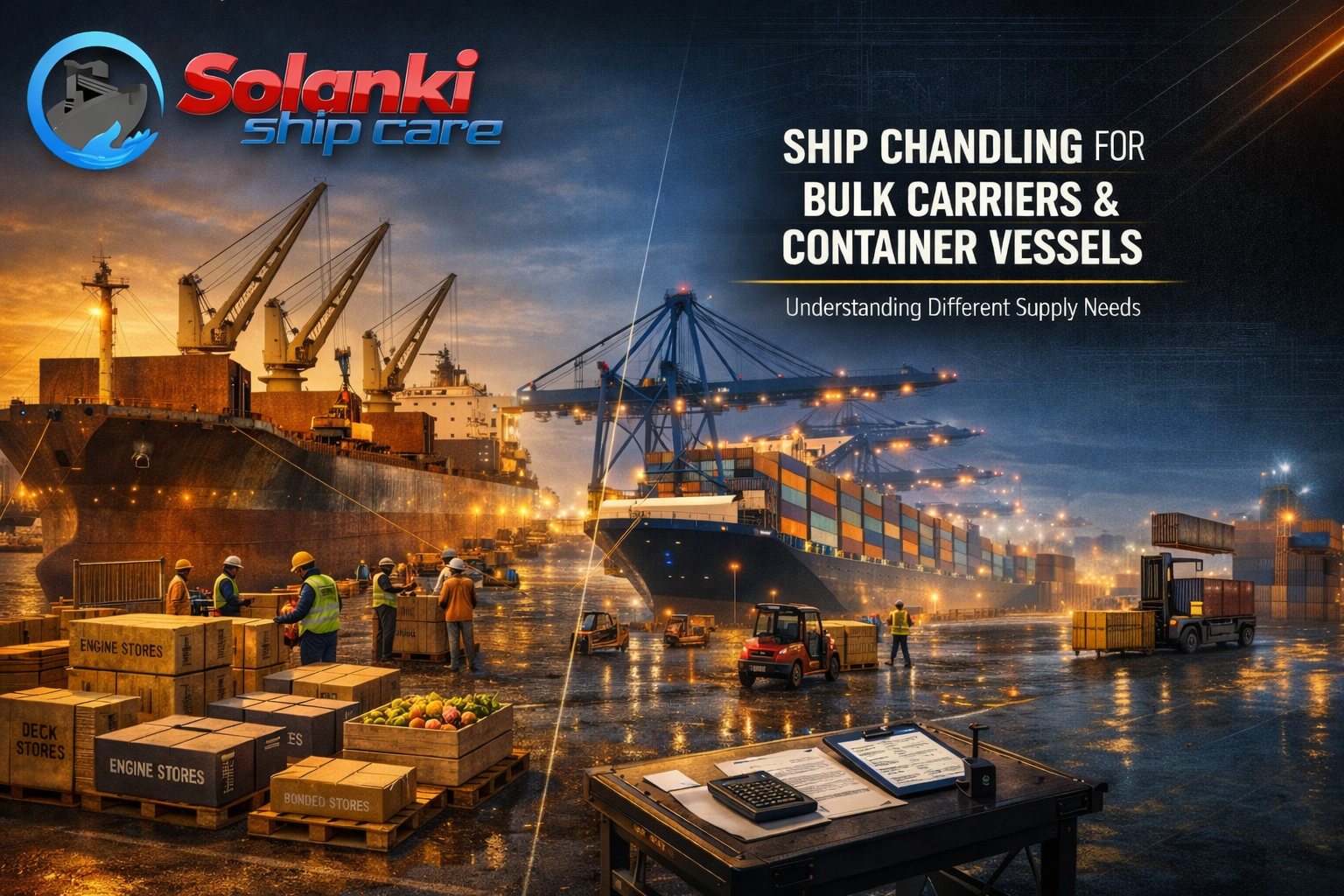
SHIP CHANDLING FOR BULK CARRIERS & CONTAINER VESSELS: UNDERSTANDING DIFFERENT SUPPLY NEEDS
Introduction
Ship chandling plays a vital role in ensuring uninterrupted
maritime operations. However, supply requirements vary significantly between
bulk carriers and container vessels. Each vessel type operates under different
schedules, cargo handling systems, crew compositions, and turnaround times.
At Solanki Ship Care, we understand
that these operational differences require careful planning and vessel-specific
coordination. Understanding these variations allows ship suppliers to plan
accurate provisioning, coordinate efficiently during port calls, and ensure
seamless service delivery. Tailored supply strategies are essential to maintain
vessel performance, crew welfare, and commercial commitments.
1. Differences in Supply
Requirements for Bulk and Container Ships
Operational Patterns Define Supply
Planning
Bulk carriers and container vessels
operate under distinct commercial models, directly influencing their supply
needs.
Bulk
carriers typically:
• Carry large volumes of homogeneous cargo (coal, grains,
ore)
• Have longer loading and discharge durations
• Operate on variable charter routes
• Maintain moderate crew sizes
Container
vessels generally:
• Follow fixed liner schedules
• Operate with rapid port turnaround
• Have tighter delivery windows
• Carry diverse cargo in containers
For bulk carriers, supply planning
often revolves around longer port stays and flexible scheduling. In contrast,
container vessels demand rapid, highly coordinated deliveries within strict
time frames.
2. Volume-Based Provisioning and
Store Planning
Adjusting Quantities Based on Vessel
Type
Provisioning volumes differ
depending on crew strength, voyage duration, and operational tempo.
Bulk
carriers often require:
• Larger quantities of provisions for extended voyages
• Increased deck consumables for cargo hold maintenance
• Hatch cover maintenance materials
• Cleaning and hold preparation chemicals
• Spare parts for cargo handling equipment
Container
vessels typically require:
• Fast-moving engine consumables
• Reefer container monitoring supplies
• Electrical and technical spares
• Lubricants aligned with high engine workload
• Quick replenishment of bonded and cabin stores
Accurate volume-based estimation
ensures adequate stock levels without overloading storage spaces. Efficient
store planning balances safety margins with cost control.
3. Coordination Challenges for
Different Vessel Types
Synchronizing Deliveries with Cargo
Operations
Each vessel type presents unique
coordination challenges.
For
bulk carriers:
• Cargo dust and loading equipment may restrict safe
delivery access
• Supply timing must align with loading/discharge shifts
• Anchorage deliveries may require launch coordination
For
container vessels:
• Extremely short port stays (sometimes under 24 hours)
• Strict terminal security procedures
• Simultaneous crane operations
• Limited deck access during cargo handling
Efficient coordination requires
advance documentation, security clearance, and precise scheduling to avoid
operational disruption.
4. Time Management During Port Stays
Maximizing Efficiency Within Limited
Windows
Time management is critical,
especially for container ships operating on fixed liner services.
Bulk carriers often allow more
flexibility during cargo discharge, enabling phased deliveries. However,
container vessels demand:
• Pre-arranged supply packages
• Pre-approved documentation
• Rapid onboard transfer procedures
• Real-time coordination with vessel agents
• Strict adherence to berth schedules
Failure to deliver within allocated
time can result in missed sailings and financial penalties. Proper planning
ensures smooth execution without delaying vessel departure.
5. Department-Specific Store
Requirements
Engine, Deck, Galley & Bonded
Stores
Both vessel types require
comprehensive supply coverage across departments, but focus areas differ.
Bulk
carriers emphasize:
• Hatch sealing tapes and steel maintenance materials
• Cargo hold cleaning chemicals
• Grease and mechanical spares
• Heavy-duty PPE for cargo operations
Container
vessels emphasize:
• Electrical tools and monitoring devices
• Reefer spare parts
• High-frequency lubrication products
• Bridge consumables for navigation equipment
Provisioning strategies must
consider technical priorities unique to each ship category.
6. How Solanki Ship Care Handles
Vessel-Specific Supply Needs
Customized Marine Supply Solutions
Across Indian Ports
Solanki Ship Care understands the
operational differences between bulk carriers and container vessels. Our team
develops vessel-specific supply plans to ensure efficient and timely service
delivery.
Our
services include:
• Detailed pre-arrival supply coordination
• Volume-based provisioning as per crew strength and voyage plan
• Engine, deck, galley, and bonded store supply
• Emergency spare sourcing
• Anchorage and berth delivery support
• Compliance with port and terminal regulations
• Fast turnaround coordination for liner vessels
With strong vendor networks and
operational expertise, Solanki Ship Care ensures that both bulk carriers and
container vessels receive precisely planned, high-quality supplies without
disrupting port operations.
Conclusion
Ensuring Operational Efficiency
Through Tailored Ship Chandling
Ship chandling for bulk carriers and
container vessels requires strategic planning, operational awareness, and
precise coordination. Differences in scheduling, cargo operations, and crew
requirements demand customized provisioning approaches.
By understanding vessel-specific
supply dynamics and implementing structured planning, maritime operators can
avoid shortages, reduce delays, and protect commercial performance.
Through professional coordination
and dependable service, Solanki Ship Care remains committed to delivering
reliable marine supply solutions tailored to every vessel type and operational
requirement.