
Jul 01, 2026
Garbage Record Books Explained: A Practical Guide for Vessel Compliance
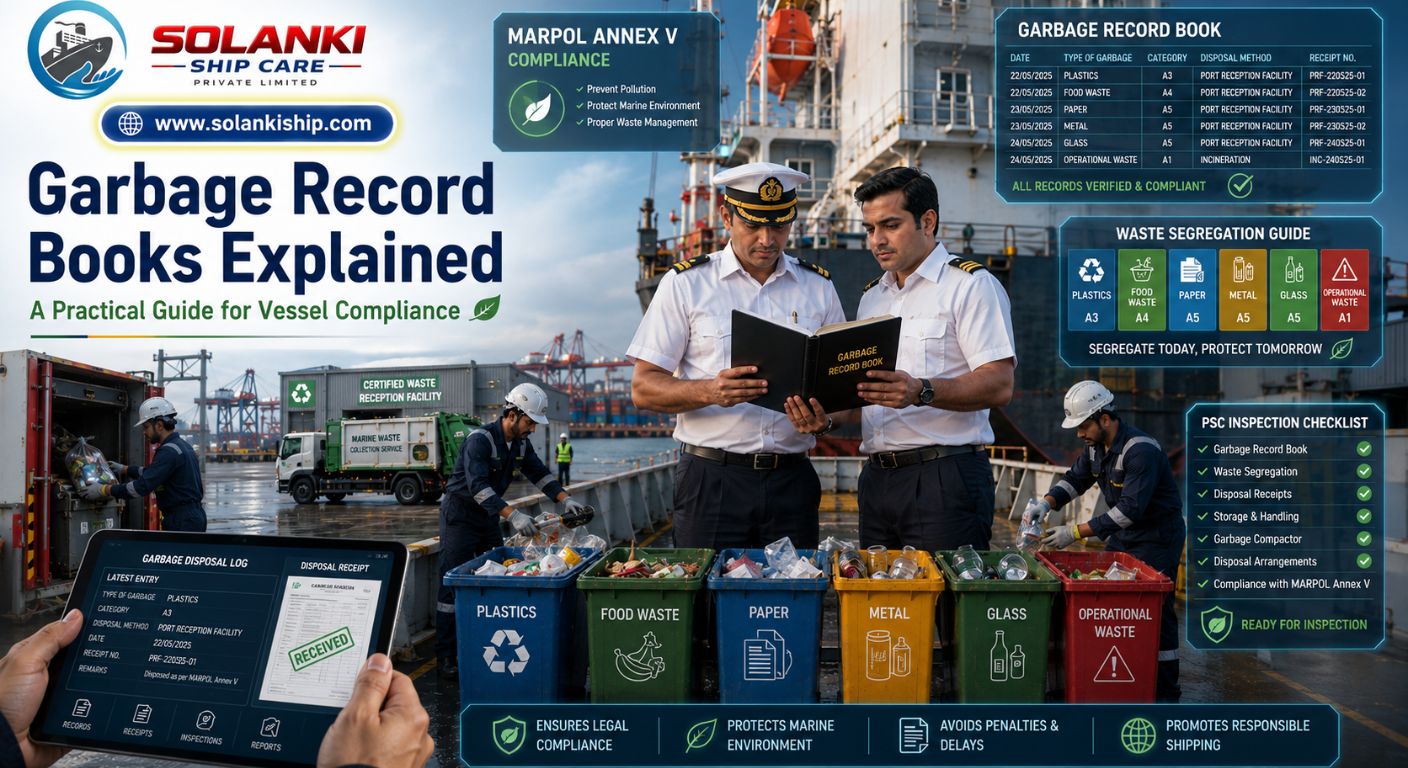
Garbage generated onboard ships must
be managed responsibly to comply with MARPOL Annex V and protect the marine
environment. Maintaining an accurate Garbage Record Book (GRB) helps vessels
demonstrate compliance and pass Port State Control (PSC) inspections. Solanki
Ship Care supports vessels with certified garbage disposal services and
complete documentation across major Indian ports.
Understanding
the Purpose of the Garbage Record Book
The Garbage Record Book is an
official document required under MARPOL Annex V that records all garbage
disposal activities carried out onboard a vessel. It helps demonstrate
compliance with international environmental regulations by documenting the collection,
storage, discharge, incineration, and transfer of garbage to authorized shore
reception facilities. Maintaining accurate records promotes responsible waste
management, protects the marine environment, and ensures vessels remain
inspection-ready. learn more at Solanki Ship Care.
1. Purpose of
the Garbage Record Book
The Garbage Record Book serves as an
official record of all garbage management activities onboard a vessel. It helps
ship operators comply with MARPOL Annex V, maintain transparency in waste
handling, and demonstrate responsible environmental practices during
inspections.
2. Recording
Garbage Disposal Activities Correctly
Every garbage disposal activity
should be recorded immediately after completion. Each entry should include the
date, time, vessel position or port, garbage category, quantity disposed,
disposal method, and the responsible officer's signature. Supporting documents
such as garbage reception receipts should also be retained for verification
during inspections.
3. Common
Mistakes During Inspections
Inspection deficiencies often result
from incomplete or inaccurate record keeping. Common mistakes include missing
entries, incorrect garbage categories, inaccurate quantities, delayed updates,
missing signatures, and inconsistencies between disposal receipts and the
Garbage Record Book. Regular crew training and internal checks help prevent
these issues.
4. Importance
During Port State Control (PSC) Checks
The Garbage Record Book is one of
the primary documents reviewed during Port State Control inspections.
Inspectors compare the entries with garbage storage, disposal receipts, voyage
details, and the vessel's Garbage Management Plan. Accurate documentation helps
avoid deficiencies, penalties, operational delays, and demonstrates compliance
with MARPOL Annex V.
5. How Solanki
Ship Care Supports Compliant Garbage Disposal
Solanki Ship Care provides
professional and certified garbage disposal services across major Indian ports.
Our experienced team coordinates safe garbage collection, transportation, and
disposal through authorized reception facilities while providing complete
MARPOL-compliant documentation and disposal certificates. Our reliable services
help vessels maintain environmental compliance and minimize port delays.
Conclusion
Maintaining an accurate Garbage
Record Book is essential for compliance and responsible vessel operations.
Proper record keeping and adherence to MARPOL Annex V help vessels pass
inspections and avoid penalties. Partnering with Solanki Ship Care ensures
certified disposal, reliable documentation, and compliant waste management
across Indian ports. visit Solanki Ship Care.
Frequently Asked
Questions (FAQ)
Q1. What is a Garbage Record Book?
A MARPOL Annex V log for recording onboard garbage disposal.
Q2. Why is it important?
It proves compliance and helps pass inspections.
Q3. What should be recorded?
Date, time, location, type, quantity, method, and signature.
Q4. Common inspection mistakes?
Missing entries, wrong categories, incorrect quantities, delays, no signatures.
Q5. How does Solanki Ship Care help?
Provides certified disposal, documentation, and reliable services.