
Aug 01, 2026
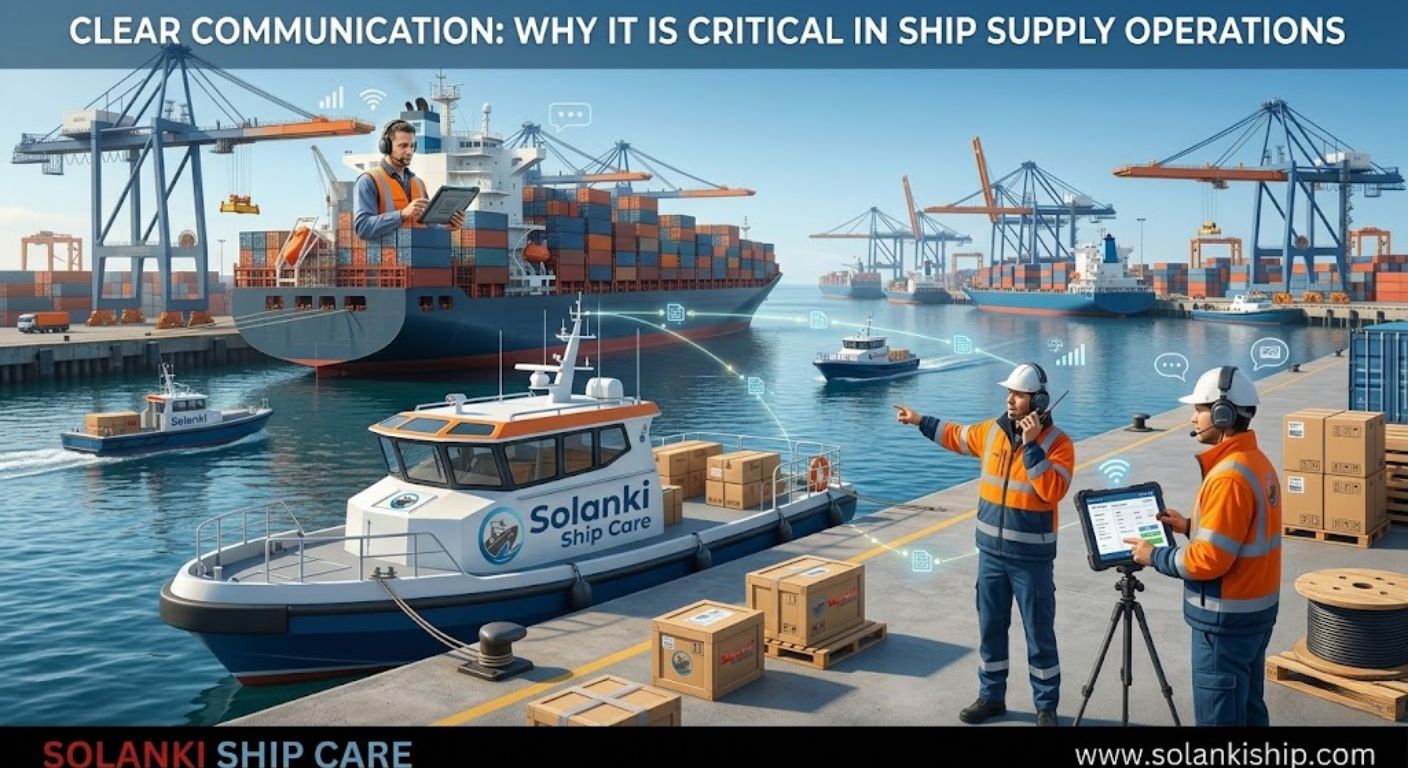
CLEAR COMMUNICATION: WHY IT IS CRITICAL IN SHIP SUPPLY OPERATIONS | SOLANKI SHIP CARE
Solanki Ship Care ensures seamless ship supply
operations across all major Indian ports by maintaining clear, timely, and
accurate communication between vessel crews, suppliers, port agents, and
logistics teams minimizing delays, avoiding errors, and ensuring efficient
delivery at Mumbai, Chennai, Kandla, Visakhapatnam, Kolkata, Mundra, and more.
EFFICIENT
SHIP SUPPLY OPERATIONS THROUGH CLEAR COMMUNICATION
In the
ship supply industry, communication is not just important it is the backbone of
successful operations. From receiving supply orders to final delivery onboard,
every step depends on accurate and timely information exchange.
Miscommunication
can lead to incorrect deliveries, delays, increased costs, and operational
disruptions for vessels. Clear communication ensures that every stakeholder
from vessel crew to suppliers and port agents works in perfect coordination.
As a
trusted ship chandler across India, Solanki Ship Care (www.solankiship.com) prioritizes structured communication systems to
deliver reliable and efficient ship supply services.
1.
COMMUNICATION BETWEEN VESSEL CREW AND SUPPLIERS
Ensuring Accurate Supply Requirements
Effective
communication between vessel crew and suppliers is essential to understand
exact requirements. Every vessel has specific needs based on voyage duration,
crew size, and operational demands.
Clear
exchange of requisition lists, specifications, quantities, and delivery
timelines ensures that the right products are supplied without errors.
Continuous confirmation and clarification help avoid last-minute confusion.
Solanki
Ship Care maintains direct and transparent communication with vessel crews to
ensure that all supply requirements are clearly understood and fulfilled
accurately.
2.
PREVENTING ORDER MISUNDERSTANDINGS
Eliminating Errors in Ship Supply Orders
Order
misunderstandings are one of the most common challenges in ship supply
operations. Even a small miscommunication can result in incorrect items, wrong
quantities, or unsuitable products being delivered.
Preventive
measures include double-checking orders, maintaining written confirmations,
using standardized formats, and verifying details before dispatch. Clear
documentation plays a key role in reducing errors.
Solanki
Ship Care follows a strict order verification process to eliminate
misunderstandings and ensure that every delivery matches the vessel’s exact
requirements.
3.
REAL-TIME UPDATES DURING DELIVERY
Keeping All Stakeholders Informed
Real-time
communication during delivery is crucial to ensure smooth coordination between
teams. Vessel schedules can change, port conditions may vary, and delays can
occur unexpectedly.
Providing
live updates regarding dispatch status, estimated arrival time, and delivery
progress helps vessel crews and port agents plan accordingly. It also allows
quick adjustments when needed.
Solanki
Ship Care ensures continuous updates throughout the delivery process, enabling
efficient coordination and minimizing waiting time for vessels at port.
4.
COORDINATING WITH PORT AGENTS AND LOGISTICS TEAMS
Seamless Multi-Party Communication
Ship
supply operations involve multiple stakeholders, including port agents,
transport providers, and logistics teams. Without proper coordination, delays
and confusion can easily arise.
Clear
communication ensures alignment on delivery schedules, port entry permissions,
documentation, and handling procedures. It also helps in managing last-mile
delivery efficiently.
Solanki
Ship Care works closely with port agents and logistics partners across all
major Indian ports to ensure smooth, timely, and well-coordinated supply
operations.
5. HOW
SOLANKI SHIP CARE MAINTAINS EFFECTIVE COMMUNICATION CHANNELS
Reliable and Structured Communication Systems
Solanki
Ship Care integrates strong communication practices into every stage of ship
supply operations. Their approach ensures transparency, accuracy, and
efficiency.
Their
communication system includes prompt response to inquiries, clear
documentation, real-time tracking updates, dedicated coordination teams, and
continuous follow-ups with all stakeholders.
By
maintaining structured communication channels, Solanki Ship Care ensures that
every supply operation is executed smoothly, efficiently, and without unnecessary
delays across Mumbai, Chennai, Kandla, Visakhapatnam, Kolkata, Mundra, Haldia,
Cochin, Paradip, Dahej, and all major Indian ports.
CONCLUSION
Clear
communication is the foundation of successful ship supply operations. It
ensures accurate order fulfillment, prevents costly errors, enables real-time
coordination, and keeps all stakeholders aligned throughout the process.
By
prioritizing transparency, timely updates, and structured communication
systems, Solanki Ship Care delivers reliable and efficient ship chandling
services across all major Indian ports. Their commitment to precision,
coordination, and professionalism makes them a trusted partner in the maritime
industry.
For
efficient, reliable, and well-coordinated ship supply services across all major
Indian ports, contact Solanki Ship Care at www.solankiship.com.
FREQUENTLY
ASKED QUESTIONS (FAQ)
Q1. Why
is communication important in ship supply operations?
Clear communication ensures accurate order fulfillment, prevents delays, and
enables smooth coordination between vessel crew, suppliers, and port teams.
Q2. How
can order misunderstandings be prevented?
Order misunderstandings can be avoided through written confirmations,
standardized formats, and double-checking all details before dispatch.
Q3. Why
are real-time updates important during delivery?
Real-time updates help manage schedule changes, reduce waiting time, and allow
quick decision-making during supply operations.
Q4. Who
are involved in ship supply communication?
Key stakeholders include vessel crew, suppliers, port agents, logistics teams,
and transport providers.
Q5. How
does Solanki Ship Care maintain effective communication?
They use structured communication systems, dedicated coordination teams,
real-time updates, and continuous follow-ups to ensure smooth and efficient
operations.